Research
PrismEvidence first. Judgement second.
Point Prism at any URL. It crawls, fingerprints, audits, and researches the site, then compiles an evidence-backed dossier as Markdown, JSON, or a self-contained HTML report.
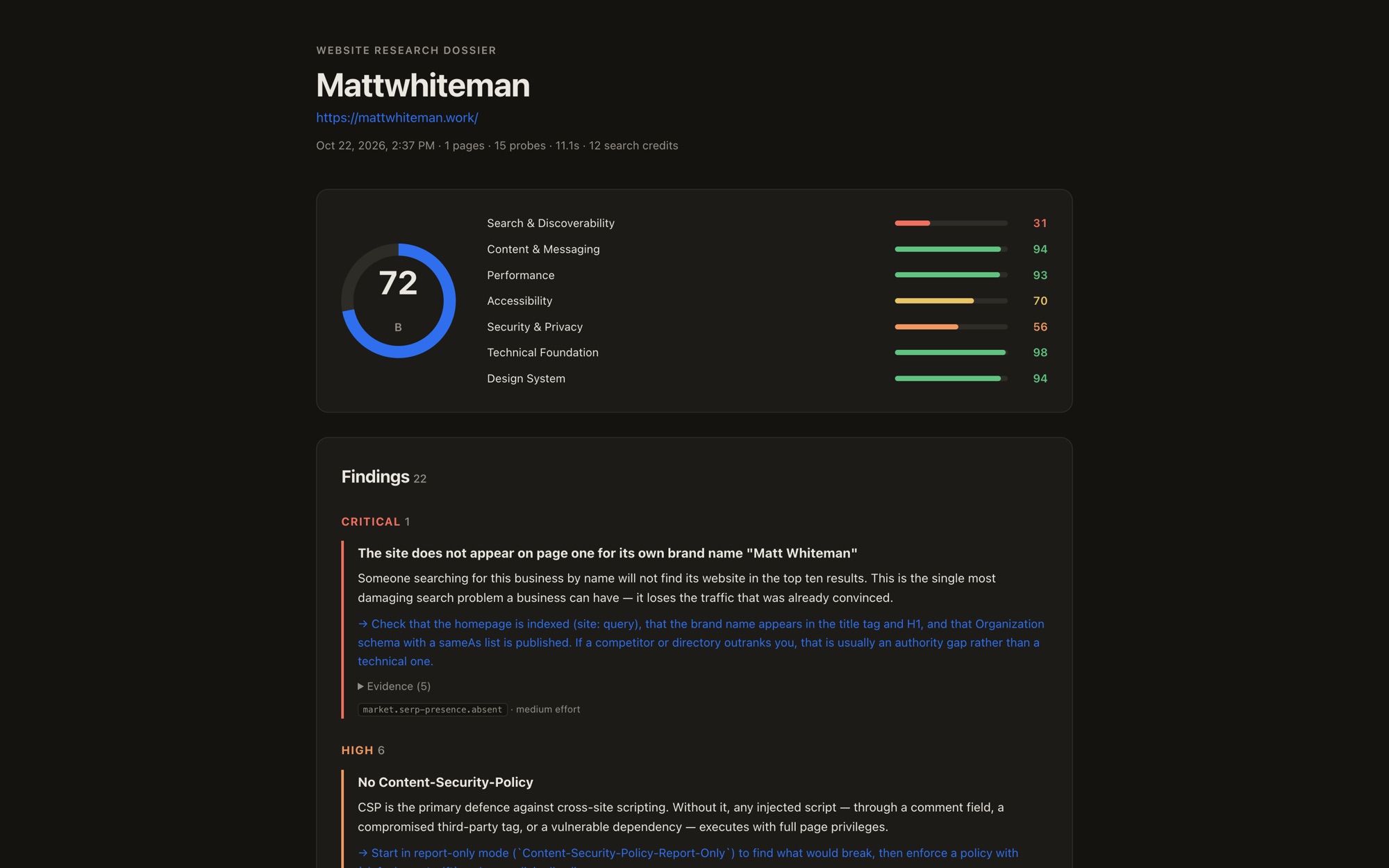
A real Prism dossier of this very website, scanned in 11 seconds.
Most audit tools say perfect about things they never checked.
Prism keeps what it measured separate from what it didn't, and shows the evidence behind every finding.
How it works
4 steps. That's it.
Point
Give it a URL and a profile, or ask a question in plain English.
Probe
Claude plans the run. Probes check the site in a real Chromium browser, in parallel.
Score
Findings are scored by fixed rules from the evidence, not by vibes.
Report
Get Markdown, JSON, or a self-contained HTML report that answers your question first.
What makes it different
Built the hard way.
On purpose.
Everything is a probe.
Each probe declares what it needs and what it costs. Adding a new research capability means writing one file.
A failing probe never fails the run.
Every probe is isolated with its own time limit. If one dies, you still get the rest, and the report says what could not be measured.
Not measured is not perfect.
A dimension with no evidence scores null, never 100. That is how audit tools stop lying.
Deadline-aware.
A crawl that runs out of time returns the pages it reached and flags the gap, instead of throwing the work away.
Ask it anything.
“Is this a credible vendor for an enterprise buy?” Prism picks the probes that answer it.
Rebuild-ready.
It extracts design tokens and component interfaces, so a site can be rebuilt from the dossier.
“Not measured” and “perfect” are different claims.
Who it's for
For anyone who audits, researches, or rebuilds websites: SEO, security, competitive analysis, vendor checks. And for AI agents, through its MCP server.
- TypeScript
- Real Chromium via Playwright
- CLI, library, and MCP server
Prism.
Evidence first. Judgement second.
Next up
DevSearch →