Orchestration
TrellisWorkflows with receipts.
A multi-agent orchestration platform. Draw the workflow; a durable engine runs it. Each box is a unit of work: an AI agent, a program, a decision, or a human approval.
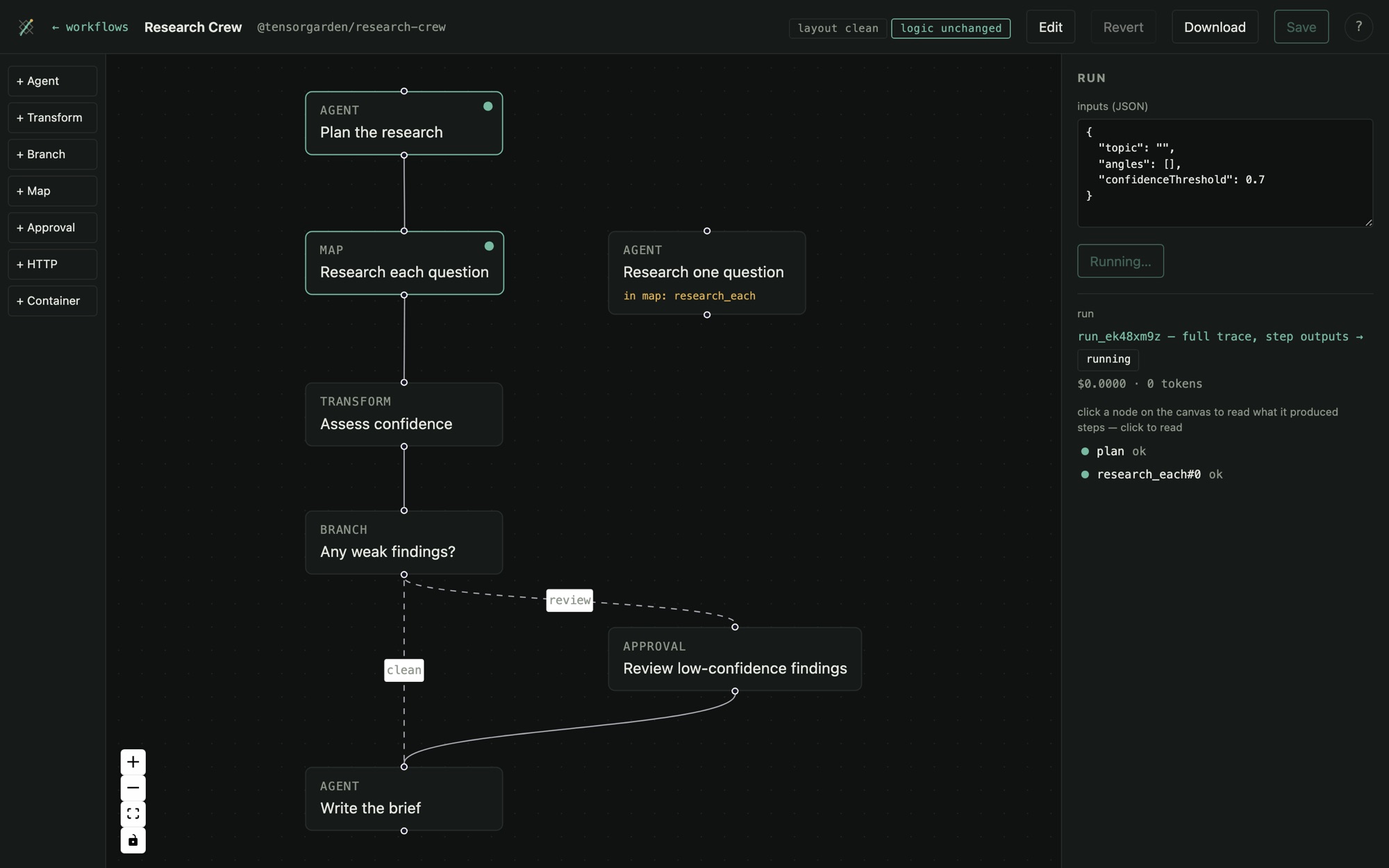
Trellis Studio, mid-run: plan, research in parallel, assess, branch, and a human approval gate before the brief is written.
AI agents are powerful. Trusting them is the hard part.
Agent runs crash halfway, leak credentials, and act before anyone checks. Trellis is the fixed structure underneath: durable, governed workflows where every step keeps receipts.
How it works
4 steps. That's it.
Build
Draw the workflow on a visual canvas or write it by hand. Both produce the same definition, kept in git.
Run
Start it from the Studio, the command line, the HTTP API, a webhook, or a schedule.
Govern
Agents call tools and loop. Approval gates pause the run until a named person decides.
Recover
If it crashes, resume it. Finished steps are restored from checkpoints, never re-run.
What makes it different
Built the hard way.
On purpose.
Canvas and code are one artifact.
Drag a box in the Studio and only the layout changes. A visual tidy-up never shows up as a logic change in code review.
Silence means no.
An approval gate nobody answers is denied by default. Nothing proceeds past a human gate without a named person approving.
Declared means enforced.
A container step that declares no network access runs with no network at all. The rules live in the engine, not in a wiki.
Secrets stay secret.
The credential vault is encrypted at rest with AES-256-GCM. Credentials are lent between organizations one at a time, and no route ever returns a stored value.
Built to survive a kill.
Runs survive a real kill signal mid-run and pick up where they left off. SQLite and Postgres pass the same test suite.
Approve from your menu bar.
A native macOS companion puts Approve and Deny right in the notification, so a gate never waits on a browser tab.
The deterministic workflow layer is the trellis; the agents are what grows on it.
Who it's for
For teams that want AI agents doing real, multi-step work: operators in a visual builder, engineers in code, and everyone reading the same receipts.
- TypeScript engine
- Next.js Studio
- SQLite or Postgres
- Native macOS companion
- 330+ tests
Trellis.
Workflows with receipts.
Next up
SopWow →